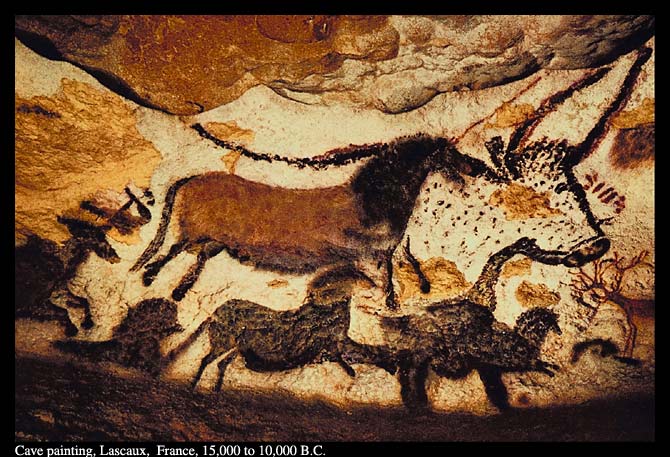
From these ancient great pieces of art one can gain a lot. Most cave paintings were very good at achieving the most basic form of a creature and the style and line work is beautiful. They overlap and even manage to capture motion in their simplistic line drawings. I would like to learn how to be able to capture such motion so simply as it would help my future as an animator and in storyboarding. The many recreations of gods and of myths greatly inspires me as well as they are portrayed fantastically with great strength and stories to go along with them. Contemporary artists due draw influence from these pieces as constant recreations are made of ancient art. The fantastic architecture still inspires great movies and stories to be made as to what happened at those places. People taking great Egyptian and Greek myths and retelling them through movies and plays. From looking at these ancient pieces and the start of painting and sculpture one can see how these art forms have become what they are today. The advancement from simple line drawing, to painted in carvings, and the change from simple stone statues to the Giant Sphinx. I find that some pieces from this time are almost more skillfully built than some built now even with all our advancements in technology. As this is the case, we still have lots that we can learn and be influenced by from these ancient pieces of art. The ability to capture a more simple refined beauty.
The topic and period that interested me the most was the The Old Kingdom in Egypt and the mysteries that it brought. Within this period the Great Pyramids were created as well as the Giant Sphinx and stone carvings of Khafre, and Menkaure and a Queen. I found the mystery of how these giant carvings and pyramids were created intriguing as to this day they are still in very good shape and were created with very basic tools and no machinery to move the giant pieces of stone. With the sphinx also comes a mystery as to who the face on the giant sphinx is supposed to be. However most evidence points towards it being Khafra. Egyptian culture has always intrigued me and the Old Kingdom holds the most iconic egyptian examples of architecture. Some things that I was very curious about and have been very interested in are how the Sphinx and pyramids were built as well as how the mummification process was done. The pyramids were built through the use of slaves who would pull large slabs of stone on logs so they would roll and slowly build up the pyramid. The Sphinx was built with ancient tools, more than likely a hammer and chisel and was very skillfully built. As to the mummification process, when a pharaoh died they would take the body and take out the organs and preserve them for use in the afterlife. The liver, lungs, stomach, and intestines were taken out and put in jars, while the heart was left inside the body so it could be weighed in the next step in the afterlife process.
The Paleolithic period was the earliest time period in which we have been able to find art. Some notable discoveries from the Paleolithic period include the Woman from Willendorf, Wall Painting with Horses, Rhinoceroses, and Aurochs in the Chauvet Cave, and Bison in Spain. These were cave paintings and sculptures. The sculpture Woman from Willendorf is a very crude sculpture, emphasizing the fertility of women through its proportions. The cave paintings were made from a mix of charcoal and animal fat and have remained preserved for thousands of years, often in air tight caves. After the Paleolithic Period came the Neolithic period in which pieces such as New Grange and Stonehenge were created. These places puzzled archaeologists as they struggled to understand how such places were carved and created with such primitive tools. The next time period in which art was found from, was Sumer. Both in its first and second period. Art from these periods showed the advancement of sculpture and the use of paint to color sculptures such as The Great Lyre with Bull’s Head in Iraq. The Babylon period while under the control of Hammurabi yielded The Stele of Hammurabi in Iran; a detailed carving into stone. Through the Assyrian, Neo-Babylonian and Persian periods one can see the advancement of sculpture and masonry as well as mastering the use of paint on these surfaces. The Egyptians after them continued this advancement of stone as they created great pyramids and the Giant Sphinx. During this time in Crete the “Palace” and the Bull Leaping were created in Crete. The “Palace” inspired by the myth of the Minotaur and the Labyrinth. In the Helladic culture stone was being used for building and people made jewelry and reconstructions of the face in gold. Through these periods art and architecture has advanced from simple charcoal drawings to painted detailed sculptures and giant buildings that we would struggle to create today.